Choosing custom cabinets is about much more than deciding how doors and drawers should look. It is also about choosing the people who will listen to your ideas, work through details with you, build the cabinetry, and remain available when questions arise later. Working with local cabinet makers can make that experience more personal because clients stay connected to the people responsible for their project from the first conversation through delivery and beyond.
At Smith & Vallee Cabinet Makers, we have been building residential custom cabinetry in Edison, Washington, since 1997. From our Skagit Valley workshop near Bow, our small, highly skilled team works collaboratively on every project. Rather than dividing projects among disconnected departments, team members contribute their expertise at different stages and adapt to the needs of each custom job. We bring that same collaborative approach to our relationships with homeowners, builders, architects, and designers throughout Western Washington.
What Does a Local Cabinet Maker Actually Do?
A local cabinet maker designs and builds cabinetry specifically for an individual home rather than adapting standardized cabinet sizes to the room. At Smith & Vallee, every job is custom. We follow an established process for moving a project from an initial conversation through design and fabrication, but the cabinetry itself starts from scratch after we learn about the client, the project, and what the space needs to accomplish.
Custom cabinetry is cabinetry designed and fabricated specifically for an individual client’s space, functional needs, and desired appearance. That means the process can account for everything from appliances and storage habits to wood choices, internal hardware, and the way a homeowner wants to use a particular cabinet every day.
Working locally also keeps communication closer to the people actually designing and building the cabinetry. At Smith & Vallee, design and fabrication are handled by our team in Edison rather than being split among several unrelated companies.
Why Does Local Knowledge Matter for Custom Cabinets?
For Smith & Vallee, the advantage of being local is less about simply knowing Western Washington architecture and more about creating a close working relationship with each client.
Every project follows a familiar path through our shop, but each one begins with a fresh conversation. We want to understand what the client is trying to create before deciding how the cabinetry should be designed.
That conversation continues as the project moves forward. Clients initially work with Ryan and Wes to discuss the project’s scope and goals. Aric and Byron then help translate those conversations into drawings for the cabinet boxes, panels, and other components needed for the project. As fabrication progresses, Ben and Tanner are involved in building and delivering the cabinetry. Because we are a small, collaborative shop, these stages remain connected rather than operating as isolated departments.
Clients also know where their cabinetry comes from. Smith & Vallee encourages people to visit the Edison shop and see the process firsthand. Online images are useful for exploring ideas and understanding the character of our work, while a shop visit adds another perspective by allowing clients to see where cabinetry is made, how our team works together, and how details move from drawings into actual components.
For many clients, that visit is also convenient. The nature of Smith & Vallee’s work means many projects are within a relatively short drive of the Edison shop, including homes around Bow, Bellingham, Anacortes, Skagit County, and other parts of Western Washington. We value being part of the Edison community and aim to be good neighbors in the place where we work.
Local Cabinet Makers Can Make Collaboration Easier
Custom cabinetry involves many decisions, and collaboration is not limited to an initial design meeting. There can be considerable back and forth as ideas develop. Homeowners may reconsider a drawer configuration, appliance location, internal hardware solution, wood choice, or another detail after seeing how the project is taking shape.
A smaller team can make these conversations more direct. Instead of selecting a standard configuration from a catalog, homeowners can explain what is not working in their current space, what they want the new cabinetry to accomplish, and even very specific habits that the cabinetry needs to accommodate.
That collaboration also extends to architects, interior designers, builders, and other professionals involved in the project. Because Smith & Vallee remains engaged throughout the process, questions can be discussed with the people who understand how the cabinetry was designed and fabricated.
When Are On-Site Cabinet Measurements Taken?
Many homeowners wonder when a custom cabinet maker comes to the house for exact measurements.
At Smith & Vallee, the detailed on-site measurement visit occurs after the client has made a deposit. This allows the team to verify real-world dimensions as the project moves from planning toward detailed production. On-site cabinet measurement is important to verify actual room dimensions and architectural conditions before custom cabinetry is fabricated.
Accurate measurements matter because small dimensional differences can affect appliance clearances, fillers, countertops, doors, drawers, and alignment with nearby architectural features.
Local Manufacturing Provides Greater Control Over Craftsmanship
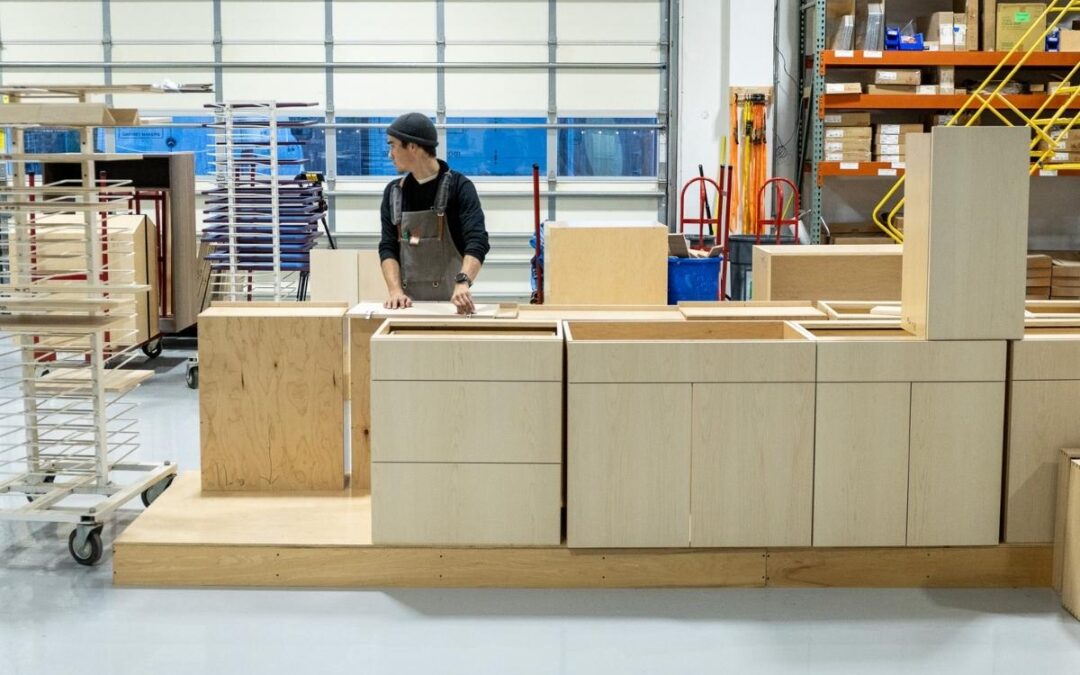
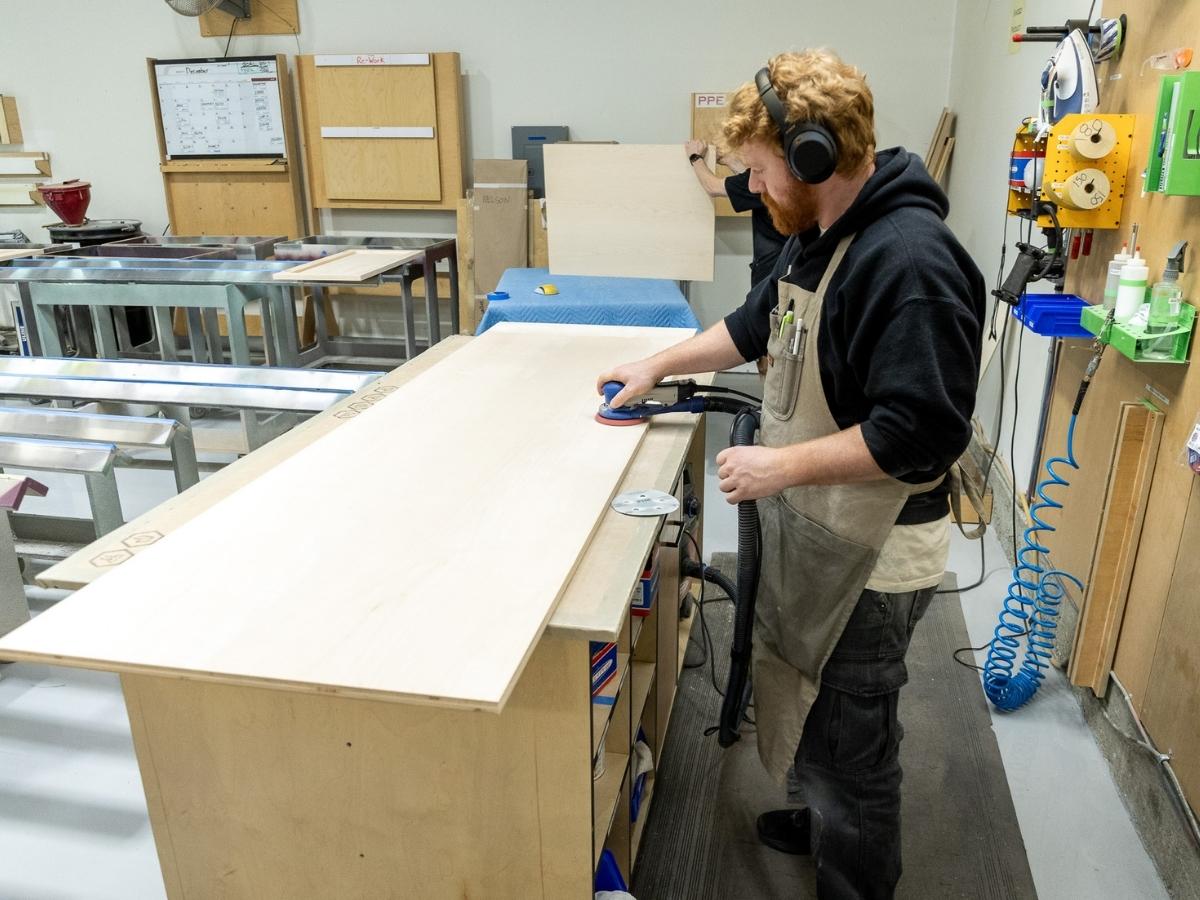
Another advantage of choosing local cabinet makers is knowing where and how the cabinetry is built. Smith & Vallee designs and fabricates its cabinetry in-house at its Edison workshop, allowing the people discussing the project with the client to remain closely connected with the people turning those plans into cabinetry.
That is particularly valuable in a small shop where team members play multiple roles. Custom projects do not always follow an identical path, so our team adapts as each job develops. That flexibility allows different skills and perspectives to come together when a project presents an unusual detail or a client asks for something outside a standard cabinet configuration.
Quality remains important throughout that process. Cabinetry is used constantly, so construction methods, joinery, drawer quality, hardware, fabrication accuracy, and protective topcoats all contribute to how cabinetry performs over time.
| Cabinet Detail | Why It Matters |
|---|---|
| Dovetail drawer joinery | Creates strong mechanical connections suited to repeated use |
| Solid maple drawer boxes | Provides a durable drawer structure with a refined appearance |
| Soft-close hardware | Helps doors and drawers operate smoothly and quietly |
| Precision fabrication | Supports consistent reveals, alignment, and fit |
| Specialty internal hardware | Allows storage to respond to specific household needs |
| Protective topcoats | Help cabinetry withstand conditions associated with its intended location and use |
Custom Hardware Can Solve Real Storage Problems
Hardware may seem like a small part of cabinet design, but some of the most useful custom solutions begin with a very specific request from a homeowner.
Smith & Vallee has hardware systems it trusts and uses regularly, including products from established manufacturers such as Blum and Kesseböhmer. Specialty hardware, however, varies from project to project. Rather than adding a mechanism simply because it is novel, we look for durable solutions that answer the way a particular client wants to live.
Sometimes those needs are extremely specific. A homeowner may want a place to hang clothes to dry within a laundry area. Someone may have a particular blender that needs to live beside the pantry on its own rollout shelf so it can be accessed without lifting it from another cabinet. Another household may want a dedicated cabinet where phones, tablets, and other electronics can charge conveniently without creating visible clutter.
These examples demonstrate why custom cabinetry involves so much conversation. The best storage solution may not become apparent until a client explains a small frustration or routine from everyday life.
Seeing these systems operate firsthand can also be valuable. Images provide a convenient way to explore possibilities before a visit, while interacting with drawer systems, hinges, pull-outs, and other internal hardware at the shop can give homeowners a better sense of movement, quality, and everyday usability.
Does Working Locally Mean You Have More Design Flexibility?
Often, yes. One of the main reasons homeowners choose custom cabinetry is the ability to design around their space rather than around predetermined product dimensions.
A local custom cabinet maker can consider the entire room. Cabinet dimensions, storage configurations, appliance placement, wood choice, door style, and architectural relationships can be developed as part of a single design.
At Smith & Vallee, design flexibility can also mean adapting to what a homeowner already has. Not every project starts with an empty room or a complete remodel. Some clients have older homes with existing cabinetry they want to preserve, update, or expand rather than replace entirely.
In these situations, the challenge may involve designing new cabinetry that feels at home beside the existing work. Smith & Vallee can consider complementary wood choices and work to match existing stains and finishes so that additions relate thoughtfully to the cabinetry and character already present in the home.
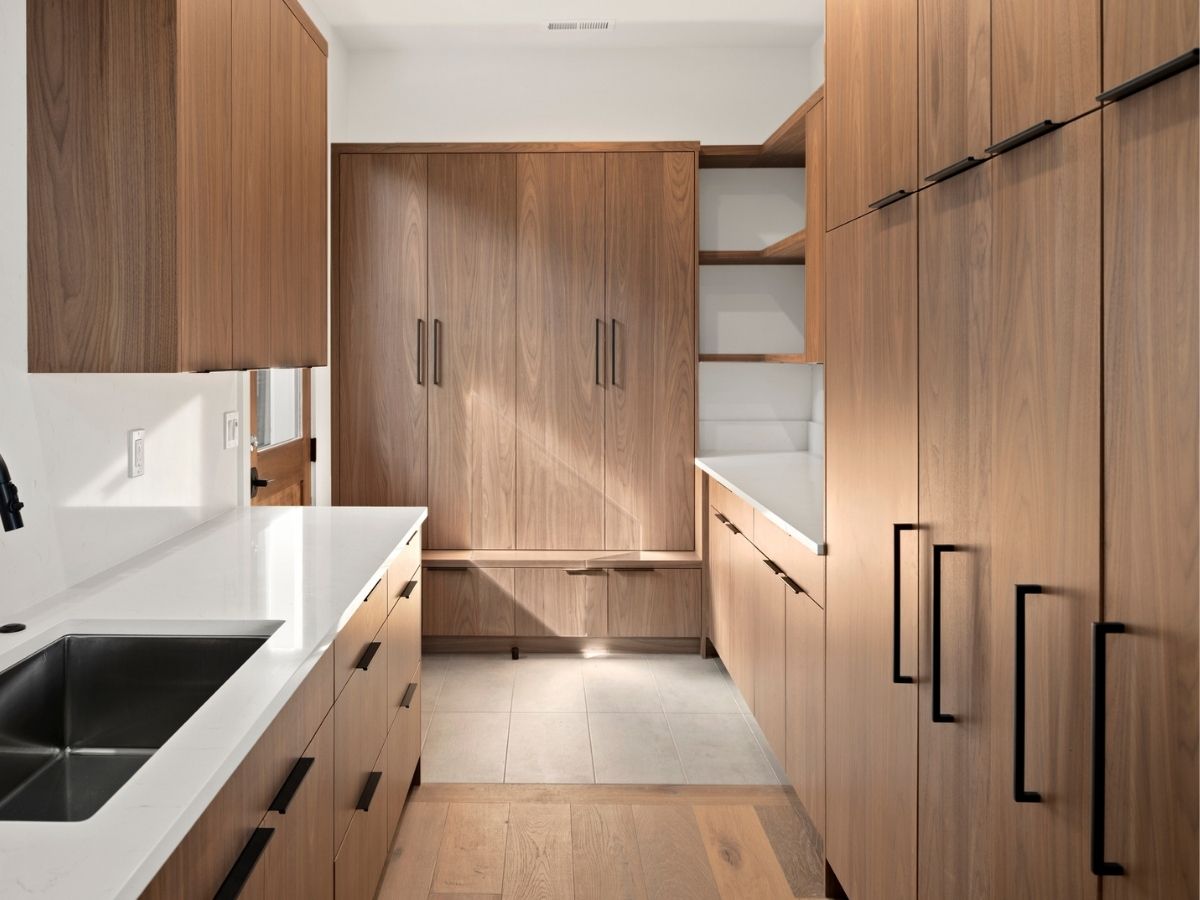
This flexibility is useful beyond kitchens. Smith & Vallee creates cabinetry for bathrooms, home offices, mudrooms, laundry spaces, and other residential areas where generic storage may fail to support daily routines.
Functional cabinet design organizes storage according to what needs to be stored, where it is used, and how frequently the homeowner needs to access it. That is why good custom design usually starts with questions about everyday life rather than appearance alone.
How Do Wood Choice and Finishing Affect Custom Cabinetry?
Wood species play an important visual role in custom cabinetry. Walnut, cherry, maple, oak, sapele, and other hardwoods each create distinct grain patterns, tones, and overall character. In existing homes, wood choice may also be considered in relation to cabinetry, furniture, trim, and architectural details already in the space. The goal does not always have to be an exact visual duplicate. A carefully chosen wood can complement the character of the existing home.
Finishing becomes particularly important when new cabinetry is being added alongside older work. Smith & Vallee has experience matching existing stains and finishes when a project calls for continuity. The team also considers the location and expected use of each new component when sealing and topcoating cabinetry, including whether a surface will experience frequent handling or possible moisture exposure.
Long-term cabinet performance still depends on more than appearance. Thoughtful construction, quality components, appropriate hardware, careful fabrication, and finishing suited to the cabinetry’s intended use all contribute to how the finished piece performs.
What Happens When It Is Time to Install Custom Cabinets?
Installation is an important distinction homeowners should understand before choosing a cabinet maker.
Smith & Vallee does not install its cabinetry directly. Instead, the company works with installers it knows and likes, or coordinates with the client’s contractor or installation professional.
Smith & Vallee remains available throughout this stage to answer questions and provide support. That continuity helps installers understand design intent and gives homeowners access to the people who designed and fabricated their cabinets if questions arise.
What is especially important is that Smith & Vallee’s involvement does not end when the cabinets leave the shop. Our team remains available during installation to answer questions, clarify details, and provide information to the people working with the cabinetry onsite.
That availability continues after delivery because real-world questions sometimes emerge only once cabinetry is being installed or used. Clients can return to the team that knows the project rather than having to explain the cabinetry to someone unfamiliar with it. We want clients and their installers to have what they need to complete the project properly and for homeowners to fully enjoy the cabinetry once it becomes part of everyday life.
Local Cabinetry Can Simplify a Complex Project
Custom cabinetry involves a chain of connected conversations. An appliance change can affect cabinet dimensions. A client’s storage idea may lead to a different hardware solution. A drawing may reveal an opportunity that was difficult to visualize during the first meeting. Installation may produce a question that requires input from someone who remembers why a particular detail was designed a certain way.
The benefit of working with a smaller local shop is that these moments remain part of the same relationship. From early conversations with Ryan and Wes, through drafting with Aric and Byron, to fabrication and delivery involving Ben and Tanner, the project moves through a team whose members collaborate closely and understand that custom work often requires adaptation.
For homeowners around Bow, Bellingham, Anacortes, Seattle, Bellevue, the San Juan Islands, and elsewhere in Western Washington, that also means knowing where the cabinetry is being made and who is making it.
Smith & Vallee is a direct manufacturer, so cabinetry moves from design through fabrication without a traditional retail intermediary. The result is a process in which the client, the design, and the people building the cabinetry remain closely connected.
What Should You Look for When Choosing a Local Cabinet Maker?
Being local is valuable, but location alone does not establish craftsmanship. Homeowners should also evaluate experience, construction standards, design capabilities, communication, hardware quality, fabrication methods, and support throughout the project.
It is equally important to ask what the working relationship will actually look like. Who will you speak with when the project begins? Who creates the drawings? Who builds the cabinetry? Can you visit the shop? And if a question comes up during installation or after delivery, will someone who knows your project still be available?
It is also useful to examine real cabinetry and internal hardware in person when possible. Look closely at drawer construction, door alignment, grain matching, hinges, pull-outs, and specialty storage systems. Open drawers and doors repeatedly. Good cabinetry should feel considered in both appearance and operation.
Smith & Vallee has been designing and building custom residential cabinetry in Edison since 1997. As a small shop, we see custom cabinetry as an ongoing collaboration rather than a product that simply moves through a production line. Each project begins with the client’s needs, moves through the hands of a closely connected team, and continues through delivery and the questions that can arise afterward.
Ultimately, the advantage of working with a local cabinet maker is having an ongoing relationship with the people responsible for your cabinetry. The cabinets may be the physical result, but communication, collaboration, adaptability, and continued support are what help turn an individual idea into cabinetry that feels genuinely suited to the homeowner.